


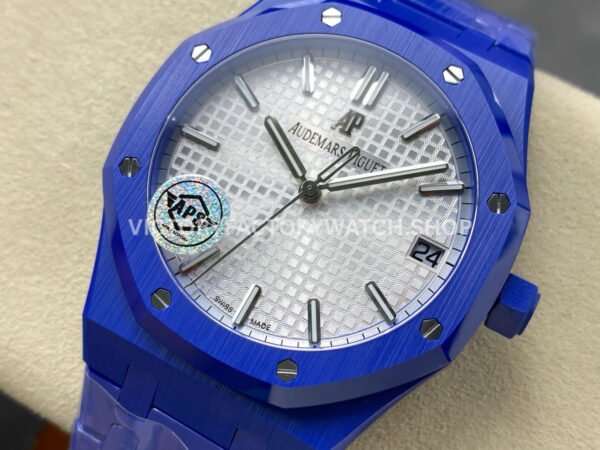
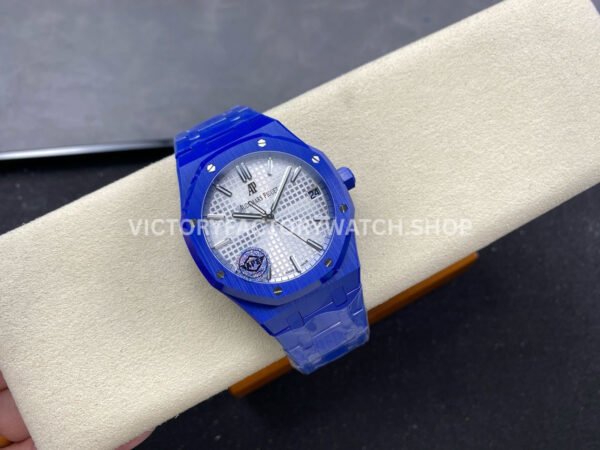












APS Factory AP Royal Oak 15500 Full Ceramic Review: What Makes This Watch Special Is Not Just the Material, but the Way It Changes the Entire Feel of the Royal Oak
The new APS Factory AP Royal Oak 15500 Full Ceramic version is the kind of watch that attracts attention immediately, and not simply because it comes in black, white, or blue. The real reason is that full ceramic changes the personality of the Royal Oak much more deeply than a normal color variation ever could.
A standard steel Royal Oak is attractive because of its sharp case lines, integrated bracelet, and cool metallic character. Once the watch moves into full ceramic, the focus begins to shift. The appeal becomes more about texture, light behavior, wearing weight, and a kind of modern distance that steel does not give in quite the same way. When this kind of watch is done well, it feels fresh, clean, and highly technical. When it is done poorly, it can end up being remembered only for the material itself, without preserving the structure and balance that make a Royal Oak interesting in the first place.
So the real question with this APS 15500 Full Ceramic is not simply whether it is ceramic. The more important question is whether APS has actually managed to merge ceramic material with the classic Royal Oak structure in a convincing way. This is not just a case of changing the shell material. It is a complete rethinking of the watch’s character.
1. Why the Appeal of a Full Ceramic 15500 Is Not Just That It Feels More Premium, but That It Feels More Distinct
After spending time around enough Royal Oak models, buyers usually split into two groups. One group still prefers the traditional steel version because it is the classic, safest, and most familiar expression of the design. The other group starts wanting something that feels more different, but without losing the core Royal Oak identity.
The full ceramic 15500 fits that second category very well.
Its attraction is not about becoming more decorative or more complicated. It is about taking a familiar Royal Oak design and shifting it into something cleaner, more modern, and more controlled. Black ceramic feels colder and sharper. White ceramic feels lighter and more unusual. Blue ceramic adds a rarer visual character that immediately separates it from the standard steel logic.
So APS is not really making an “upgraded steel 15500.” It is making a Royal Oak that speaks through a completely different material language. That is the most genuine part of its appeal. For people who already know what a steel Royal Oak looks and feels like, full ceramic is interesting because it brings real distinction rather than superficial novelty.
At the same time, it is fair to say that ceramic is also more taste-specific. If someone loves the Royal Oak mainly for its traditional metallic coldness and classic steel-watch presence, the ceramic version may not replace that in their mind. So its strength is not that it is universally better. Its strength is that it offers a more modern, material-driven interpretation of the Royal Oak.
2. Is the Real Value of Ceramic Just That It Resists Scratches Better
For many people, the first word they associate with ceramic is scratch resistance. That is true, but reducing the full ceramic 15500 to “harder to scratch” misses most of what makes it interesting.
What ceramic really changes is both the use logic and the visual logic of the watch.
On the practical side, the hardness does matter. A ceramic Royal Oak is less likely to pick up the fine daily scratches that ordinary metal surfaces inevitably collect over time. On a watch like the Royal Oak, where the bracelet and case lines are such a visible part of the design, that has real value. It helps preserve the clarity of the watch over regular wear.
But the more important point is how ceramic changes the way the watch is perceived. Ceramic does not reflect light like steel. Its surface feels deeper, cleaner, and more unified. A black ceramic Royal Oak, for example, has a level of visual calm and sharpness that steel simply does not replicate. White ceramic feels brighter and more contemporary. Blue ceramic, because it is less common, adds an immediate sense of rarity.
That said, ceramic also has its own character. It is not the same as metal, and it should not be judged by metal logic. So the real value is not “it does everything better.” The real value is that it offers stronger scratch resistance, a more intact long-term surface, and a very distinct material identity. For someone who likes ceramic, that is part of the appeal. For someone who loves only traditional metal watches, it may require a different way of thinking.
3. Why the Hardest Part of a Full Ceramic Royal Oak Is the Overall Case-and-Bracelet Integrity
A Royal Oak has never been just about the watch head.
Much of its identity lives in the one-piece logic between case and bracelet.
That becomes much harder to execute once the material is ceramic.
The reason is simple. Ceramic is not steel, and it cannot be approached in the same way. Steel allows a certain kind of traditional case finishing, edge control, and shaping. Ceramic is more difficult and more demanding, especially in a design that uses so many bracelet links, bevel transitions, and geometric surfaces.
That is why the real achievement of a full ceramic Royal Oak is not just that the material is rarer. The real achievement is whether the watch still feels like a Royal Oak after the material has changed.
If APS has truly managed to keep the case shape, bracelet articulation, beveling, and transitions clean and coherent, then this 15500 deserves more credit than a normal material variation. Because with full ceramic, any weak bracelet link, soft edge, or awkward connection between case and bracelet becomes easier to notice. The material magnifies both the difficulty and the reward.
That is why watches like this often look very simple at first, but actually depend on a huge amount of detail discipline. The advantage is clear: if done properly, the result is very striking. The reality is also clear: serious buyers will examine it more closely precisely because ceramic pushes attention toward the integrity of the full exterior.
4. What the Integrated Cal.4302 Movement Really Means on This APS 15500 Full Ceramic
APS uses an integrated Cal.4302 movement here, and for a 15500, that matters.
The reason is not just that the specification looks better on paper. The 15500 is a display caseback watch. If the entire front of the watch is built around a full ceramic, high-end material concept, but the back side reveals something that feels visually weak or disconnected, the whole product starts to lose consistency.
That is where the 4302 matters. It helps the watch feel more unified from front to back. On a full ceramic Royal Oak, the movement needs to support the same level of product logic as the exterior.
From a subjective point of view, this kind of ceramic version is already positioned as a more craft-focused and premium-feeling Royal Oak. It is not relying on one material alone to impress. The 4302 helps bring the caseback side up to the same general level, so the watch does not feel strong only from the front.
Still, it is important not to exaggerate what the movement alone can do.
The 4302 is important, but it is not the only reason this watch works or fails.
A full ceramic 15500 still stands or falls on the coordination of its material, case execution, bracelet feel, wearability, and overall coherence. The movement is a necessary part of that foundation, not a complete solution by itself.
5. Who This APS 15500 Full Ceramic Is Best Suited For, and Who It May Not Be For
This watch definitely has a point of view.
It is not the kind of Royal Oak that everyone will automatically see as the safest choice.
It feels more like a version for people who already know the standard steel models and now want something with a clearer material identity.
It suits a few specific types of buyers especially well.
First, it works for people who already like the Royal Oak design but want the watch to feel more modern, cleaner, and less vulnerable to everyday surface wear.
Second, it suits buyers who are interested in ceramic as a material in its own right, because those people tend to care about surface integrity, lighter wrist feel, and the new character that material changes bring.
Third, it is a strong fit for someone who has already seen enough ordinary steel APs and wants something more distinctive without moving into something overly decorative.
But it is not ideal for everyone.
If someone loves the Royal Oak mainly as a traditional steel icon, and they specifically want that metallic coldness, classic bracelet light play, and steel-watch presence, then full ceramic may feel more like a beautiful alternative than a true replacement.
And if someone wants the most classic, least debatable, and most universally accepted AP direction, a steel 15500 will still feel like the more traditional answer.
So the APS 15500 Full Ceramic is better understood as a Royal Oak for buyers who already know what they want, rather than a universal default option.
6. If You Had to Sum It Up Honestly, Is the APS 15500 Full Ceramic Worth Looking At
If I had to put it in the most honest way, I would say this:
What makes the APS 15500 Full Ceramic worth paying attention to is not just that it uses ceramic, but whether it manages to turn ceramic into a Royal Oak that still feels complete, balanced, and structurally convincing.
Because that is always the biggest risk with full ceramic watches.
The problem is not that they might be too unusual.
The problem is when the material stands out, but the rest of the watch does not keep up.
If APS has truly managed to coordinate the case, bracelet, bevels, wearing feel, and 4302 movement into one coherent product, then this becomes a very interesting Royal Oak. It may not be the most traditional or conservative version, but it becomes the kind of piece that makes you realize the Royal Oak can be expressed in a very different way without losing its identity.
Its strengths are easy to understand.
The material feels fresh, daily scratch resistance is more attractive, the black, white, and blue colors each push the 15500 into a character very different from steel, and the watch wears with a lighter and cleaner feel.
But realism should remain part of the discussion.
A watch like this is more dependent on material taste, and buyers will naturally pay closer attention to finishing and build quality. It also will not suit someone who simply wants the most traditional AP experience.
So in the end, this APS 15500 Full Ceramic feels less like a Royal Oak for everyone, and more like a Royal Oak for someone who already understands the design and now wants to see it pushed into a more modern, material-focused direction.
If that is what you value, then yes, it is worth serious attention.
FAQ | APS 15500 Full Ceramic
Q1: What is the biggest highlight of the APS 15500 Full Ceramic?
A: The biggest highlight is not just the rarity of the material, but the completely different texture, lighter wearing feel, and visual identity ceramic gives to the Royal Oak.
Q2: What is the most practical advantage of ceramic?
A: The most practical advantage is its high hardness and stronger scratch resistance, along with corrosion resistance and a cleaner long-term surface appearance.
Q3: Why is a full ceramic Royal Oak harder to make well?
A: Because the Royal Oak depends heavily on case-and-bracelet integration, and ceramic is much more demanding to execute cleanly across links, bevels, and structural transitions.
Q4: Who is the APS 15500 Full Ceramic best suited for?
A: It is best suited for buyers who already like the Royal Oak, are interested in ceramic as a material, and want something more modern and distinctive than a standard steel model.
Q5: What is the main realistic reservation about this watch?
A: The main realistic reservation is that full ceramic is more style-specific and more dependent on execution quality, so it may not suit buyers who simply want the most classic AP expression.
Q6: Is the Cal.4302 movement important on this watch?
A: Yes. It is important because the 15500 has a display caseback, and the movement helps keep the inside of the watch consistent with the premium logic of the ceramic exterior, although it is still only one part of the whole package.
Please identify the merchant when purchasing to prevent buying counterfeit APS Factory products.
We specialize in offering high-quality replica watches, perfectly combining exquisite craftsmanship with reasonable prices. All products are photographed in real life to ensure accurate and reliable descriptions, helping you make confident and informed purchasing decisions. Please note that watches do not come with the original brand boxes; if needed, they can be purchased separately.
We place great importance on each customer’s shopping experience. Every watch is guaranteed to match the version from the selected factory, with absolutely no bait-and-switch. Before shipping, we provide a complete video package including movement testing and actual product display to ensure accuracy. If you need specific details confirmed, we’re happy to take custom photos If the model you are looking for is not displayed on the website, please contact our professional customer service, and we will assist you in finding it.
Please note that replica watches are not genuine products and may not meet the standards of those seeking absolute perfection. If you have extremely high requirements for details, please carefully consider whether the product is suitable for you. Thank you for your understanding and support—we are committed to providing you with professional service.








Reviews
There are no reviews yet.