

Sonic Factory
Sonic Factory Background
Public information on Sonic Factory is not especially dense, but based on the forum discussions, retail circulation, and movement-reference material that have continued to appear over the last few years, its market direction is already quite clear. Its core is concentrated around two lines: the Richard Mille RM35 series and modified, skeletonized Rolex Daytona 4130 / 4131 builds. This shows that Sonic is not a broad, all-purpose factory built through large-scale multi-brand coverage, but a newer route-based factory that has gradually formed a market identity through a small number of highly recognizable, strongly modified subjects.
From the public timeline, Sonic began attracting visible market attention around 2023. Discussions on RWI about the Sonic Factory RM35-01 NTPT already developed into multi-page threads, and by 2024, Sonic was appearing in broader RM comparison contexts. That means it was not just a name sitting in seller titles, but a factory label that had entered actual collector comparison territory. By 2025, Sonic still appeared in movement-reference posts related to Richard Mille replicas, which further suggests that its market trace was not a one-off appearance.
If only the Richard Mille side is considered, the clearest subject associated with Sonic is the RM35-01 / RM35-02. These references are already among the better-known lightweight sports models in the RM family, and their importance does not lie in ordinary functions, but in whether the NTPT texture, tonneau case architecture, skeletonized visual effect, lightweight wearing feel, and overall mechanical presence come together convincingly. Public discussions mention Sonic specifically in relation to the RM35 line, and retail circulation also clearly uses the “Sonic Factory RM35-01” label. That shows it did not enter through an easy, low-threshold subject, but by choosing one of the more closely examined core directions within the RM segment.
From a product-selection standpoint, Sonic’s thinking in the RM line is not conservative. The RM35-01 already carries the Rafael Nadal-inspired sporting identity, and public materials repeatedly connect Sonic versions with keywords such as NTPT, RMUL3-style manual movement, and skeletonized dial structure. This shows that on the Richard Mille side, Sonic is not trying to create a simple, basic version. Its focus is clearly on material expression, case style, and visual mechanical drama. That kind of factory character is much closer to a theme-driven factory than to a standard mass-production source.
What gave Sonic a more distinct market image, however, was not only Richard Mille, but also its growing presence in the skeletonized Daytona modification segment. RWI movement-reference posts already list Sonic directly under “skeletonized 4130 movement from SONIC Factory.” At the same time, public retail and social content repeatedly connect Sonic Factory with open-worked 4130 Daytona builds, display casebacks, and Artisans de Genève-style hollowed mainplates. This is especially important, because it shows that Sonic’s market identity is not that of a normal production Daytona factory. It is much closer to a source recognized through a 4130 / 4131 skeleton-modification visual route.
Retail circulation further reinforces Sonic’s connection to the Artisans de Genève-style Daytona theme. Public product listings directly apply the Sonic Factory name to black skeleton Daytona builds, La Montoya-inspired versions, display-back configurations, and forged-carbon bezel expressions. These are not part of the traditional “standard replica” logic. They belong much more to a world of secondary creation, modification aesthetics, skeletonized movement presentation, and display value. This makes Sonic’s market logic relatively easy to understand. It is not trying to compete head-on with factories like Clean or BT in the most standard Daytona lane. Instead, it is building its place in a narrower segment where modified aesthetics and visual differentiation matter more.
When the RM and Daytona lines are considered together, Sonic’s factory character becomes much clearer. It is not a typical “basic-model factory,” nor the kind of maker that survives by reproducing the safest mainstream references. It is better understood as a product-driven factory built around high visual impact, skeletonized structure, modified styling, and material expression. The RM35 line represents the route of lightweight construction and case texture. The skeletonized Daytona line represents movement-focused visual modification. On the surface, they belong to different brands, but the underlying logic is the same: neither is the most conservative or basic version. Both are centered on whether the watch has enough individuality and whether the structure looks visually striking.
Because of that, Sonic’s position in the market should not be described as that of a traditional top-tier all-around factory. The public material available is still too limited to support that kind of long-term, complete, multi-brand narrative. A more realistic understanding is to place Sonic as a low- to mid-visibility factory with clear recognition inside strong-style subjects such as Richard Mille and modified Daytona builds. Its value does not come from a broad catalog, but from the fact that the directions it entered are all memorable.
From an industry perspective, this route fits very well with recent segmentation trends. As the mainstream steel-watch market becomes increasingly crowded, newer factories are less likely to enter the most competitive standard lanes directly. Instead, they move toward modified aesthetics, skeletonized visuals, and unusual material expressions, where differentiation is easier to build. Sonic’s public product distribution fits that pattern exactly: the RM35-01 NTPT represents specialized material and structure, while the AdG-style Daytona represents skeletonized mechanics and personal modification language. Neither is the easiest category to scale, but both make it much easier for the market to remember the factory name in a short time.
At the same time, Sonic still carries one practical limitation: public transparency remains limited. Most available material comes from forum discussion, social display, and retail circulation rather than from a complete long-term factory archive, systematic version records, or dense technical teardown content. That means Sonic should not be exaggerated into a long-established, fully mature, wide-coverage major factory. A more accurate definition is that it is a factory label that has gradually built recognition in visually modified, high-expression subjects over the last few years, rather than a fully developed manufacturer with complete market dominance.
Overall, Sonic Factory is best understood not as a broad, volume-driven factory built on basic models, but as a specialized factory that has gradually formed market recognition through the Richard Mille RM35 series and skeletonized modified Daytona projects. Its presence was not built through wide product spread, but through a small number of highly stylized, highly recognizable, and highly display-oriented subjects. This route is not loud, but it is much closer to the real market than vague descriptions suggesting that it “does everything,” and it fits well with the way a certain kind of newer factory emerges in the modern replica industry.
Showing all 14 results
-

Sonic Factory Richard Mille RM 055 43mm Synthetic Crystal Rubber Strap Skeletonized Dial
$1,095.00 -

Sonic Factory Richard Mille RM 055 43mm Synthetic Crystal Rubber Strap Skeletonized White Dial
$1,095.00 -

Sonic Factory Richard Mille RM 055 43mm Synthetic Crystal White Rubber Strap Skeletonized Blue Dial
$1,095.00 -
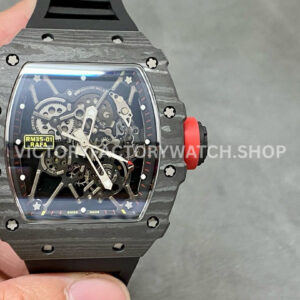
Sonic Factory Richard Mille RM 35-01 43mm Carbon Fiber Black Rubber Strap Skeletonized Dial
$995.00 -
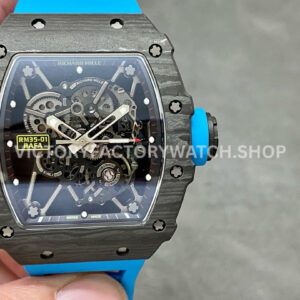
Sonic Factory Richard Mille RM 35-01 43mm Carbon Fiber Blue Rubber Strap Skeletonized Dial
$995.00 -
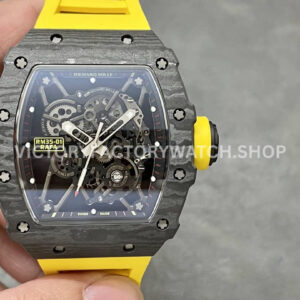
Sonic Factory Richard Mille RM 35-01 43mm Carbon Fiber Yellow Rubber Strap Skeletonized Dial
$995.00 -
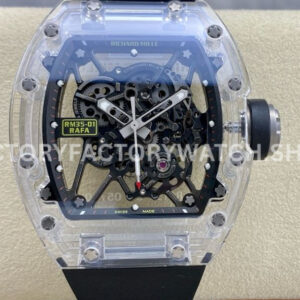
Sonic Factory Richard Mille RM 35-01 43mm Synthetic Crystal Black Rubber Strap Skeletonized Dial
$1,095.00 -

Sonic Factory Richard Mille RM 35-01 43mm Synthetic Crystal Rubber Strap Skeletonized Blue Dial
$1,095.00 -
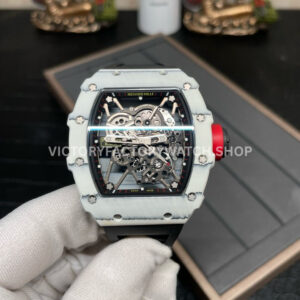
Sonic Factory Richard Mille RM 35-01 43mm White Carbon Fiber Rubber Strap Skeletonized Dial
$995.00 -
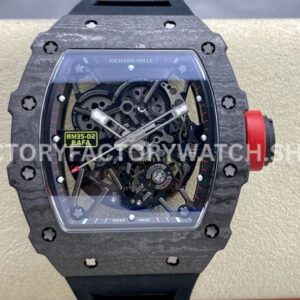
Sonic Factory Richard Mille RM 35-02 44.5mm Black Carbon Fiber Black Rubber Strap Skeletonized Dial
$995.00 -
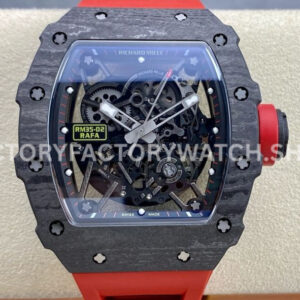
Sonic Factory Richard Mille RM 35-02 44.5mm Carbon Fiber Red Rubber Strap Skeletonized Dial
$995.00 -
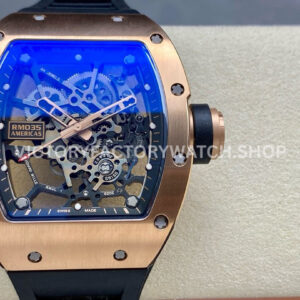
Sonic Factory Richard Mille RM035 40mm Rose Gold Rubber Strap Skeletonized Dial
$895.00 -
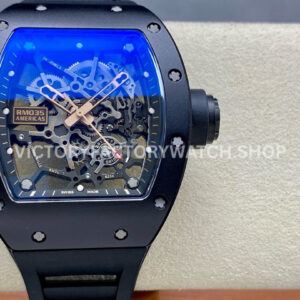
Sonic Factory Richard Mille RM035 40mm Titanium Rose Gold Rubber Strap Skeletonized Dial
$895.00 -

Sonic Factory Richard Mille RM035 40mm Titanium Rubber Strap Skeletonized Dial
$895.00