
MX Factory
MX Factory Background
In recent years, the public outline of MX Factory has become much clearer than that of many lower-visibility factories. Existing forum discussion, community sharing, and retail circulation all point in the same direction: MX is not a broad factory built through multi-brand expansion, but a specialist maker with a clearly concentrated focus on Vacheron Constantin. Its most stable and most consistently discussed public traces are centered on the Fiftysix Complete Calendar, Traditionnelle Complete Calendar, Historiques 222, and, more recently, the Patrimony ultra-thin route. That product spread already says a great deal. MX did not build presence by flooding the market with hot steel sports watches. It built recognition gradually through Vacheron Constantin subjects that lean more towards dress watches, complications, and vintage-sport aesthetics.
From a timeline perspective, MX did not enter public view especially late. By around 2021, public community discussion had already begun comparing the Vacheron Constantin Fiftysix Complete Calendar from MX with competing versions. By 2023, RWI was already carrying sustained discussion around the VC Traditionnelle Complete Calendar by MXF. Then, through 2024 and 2025, public content around the Historiques 222 and Patrimony Ultrathin continued to increase. This timeline shows that MX was never a one-off short-term label. It is a factory that has spent several years expanding within the same brand in a fairly consistent way.
If the factory’s route is reduced to its clearest characteristic, what defines MX is not sheer volume, but the fact that its subjects are tightly concentrated and all carry a distinctly Vacheron Constantin kind of character. The Fiftysix, Traditionnelle, Patrimony, and Historiques 222 look different on the surface, but their underlying logic is very similar. None of them belong to the easiest high-traffic steel sports category. They all depend much more on dial order, case proportion, thickness control, lug shape, vintage character, and the overall wearing presence of the watch. That is what makes MX’s route so revealing. It is not a factory chasing whatever happens to be the hottest. It is expanding inside a relatively coherent Vacheron Constantin design language. At the same time, the original positions of the Traditionnelle, Patrimony, and Historiques 222 within Vacheron Constantin’s own catalog already correspond to three distinct but refined identities—traditional high watchmaking, restrained dress minimalism, and vintage integrated luxury sports design—which helps explain why the market pays close attention to whether MX can get those atmospheres right.
Among the currently visible public materials, one of the earliest subjects through which MX formed a clearer market identity was the Vacheron Constantin Fiftysix Complete Calendar. In public discussion, users directly placed the MX version against the ZF version, and the comparison did not stop at whether the watch simply looked similar. It moved into more detailed points such as the caseback layout, rotor color, and whether the overall visual effect felt closer to the genuine watch. Some feedback even stated directly that the MX version looked closer to the original in certain caseback and decorative details. That kind of judgment says a lot. It means MX was not operating only at the entry-substitute level. At least on the Fiftysix line, it had already entered a real comparison environment where people were asking which version looked more convincing and more refined.
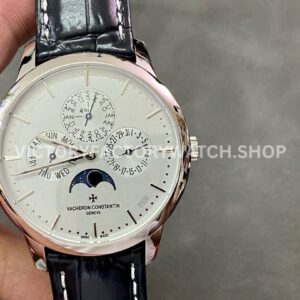
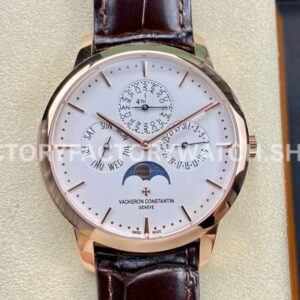
What pushed MX into a more complete factory profile within the VC segment, however, was the Traditionnelle Complete Calendar. In sustained RWI discussion around that watch, users explicitly stated that they had bought the Traditionnelle, Fiftysix, and Historiques 222, all from MX Factory. That detail is especially important, because it moves MX from the image of a single-reference factory into that of a maker with multi-subject coverage inside Vacheron Constantin. The Traditionnelle Complete Calendar is already more demanding than a basic three-hand model. The market is not only watching the exterior. It also cares about whether the day, date, month, and moonphase layout feels coordinated, and whether the watch can still preserve proper dress-watch character despite the added display complexity. Public RWI material discussing this version even places it directly in a fairly specific dimensional frame, around 41mm and 10.7mm, which shows that judgment of the watch had already moved into a more detailed level of execution.
The Historiques 222 line gave MX another kind of market presence. The 222 is one of the most sensitive Vacheron Constantin replica subjects in recent years, because it demands that the 37mm proportions, ultra-thin impression, integrated bracelet rhythm, bezel teeth, dial spacing, and overall vintage-sport atmosphere all feel right at the same time. Once MX entered this model, public forums and Reddit both began to show continuing displays, wrist shots, and even V2-type update discussion. That matters because it shows MX was not merely testing the water. It was continuing to iterate on the 222, which suggests a deliberate effort to move from “a factory that has made VC” toward “a factory with a continuous version trail in key VC references.”
At the same time, MX’s place in the 222 segment is not that of an automatic default winner. Public discussion makes that quite clear. The market seriously compares MX and PPF side by side, and the detailed points raised are very specific. In public comparisons between PPF and MXF, the discussion moves directly into areas such as the lugs, end links, clasp fixation method, bracelet curve, and thickness. One of the more intuitive takeaways is that PPF may come closer in certain original construction details, while MXF may feel smoother in bracelet wear, without being dramatically worse in thickness. Feedback like this is highly revealing. It shows exactly where MX stands in the market. It has entered the comparison group, but it is not the uncontested top answer. In the 222 segment, its value lies not in dominance, but in the fact that it has become a version the market feels compelled to take seriously.
In more recent public content, MX has also started appearing in discussions around the Patrimony ultra-thin route. RWI has already carried threads like “MXF Patrimony Ultrathin Finally?!”, which means the market has begun connecting MX with a more orthodox, more restrained, more proportion-sensitive Vacheron Constantin dress watch. That signal matters because it shows MX has not stopped at the Fiftysix, Traditionnelle, and 222—categories where it already established a base level of recognition—but is continuing to explore a direction like Patrimony, which places even greater pressure on thinness and formal elegance. For a factory whose clearest route is already centered on Vacheron Constantin, that kind of extension makes sense, and it further strengthens the market impression that MX is not just a single-model maker, but a factory gradually building a wider VC product family.
In terms of factory character, MX does not resemble the traditional “movement-myth” factory. Public discussion around it is centered much more on finishing, functionality, visual impression, caseback decoration, case proportion, and subject coverage than on some legendary fully reconstructed movement route. It is closer to a product-line factory. It goes deep into one brand, then keeps adding subjects within that brand, gradually fixing the market impression that “this factory has something in the VC space.” That route is less dramatic than the mythology built around certain clone-movement factories, but it is arguably closer to how real buyers think, because what buyers ultimately care about is whether the finished watch looks right, functions properly, and wears convincingly.
From a realistic market-positioning standpoint, MX should not be described as the absolute top Vacheron Constantin factory, because public feedback already shows that in several subjects it still sits in direct comparison with other makers rather than in an uncontested leading position. At the same time, it should not be reduced to an ordinary low-end source, because the subjects it has entered are not simple mass-market pieces. They are watches like the Fiftysix Complete Calendar, Traditionnelle Complete Calendar, Historiques 222, and Patrimony Ultrathin, all of which require proportion, functionality, and visual refinement to feel convincing. The most realistic way to place MX is as a mid-tier to upper-mid-tier specialist factory with Vacheron Constantin as its clearest main line, and one that is gradually expanding its thematic coverage within that brand.
Overall, the most accurate way to define MX Factory is not as a broad multi-brand manufacturer, but as a specialist factory that has gradually built market recognition through Vacheron Constantin subjects such as the Fiftysix, Traditionnelle, Historiques 222, and Patrimony. Its market presence was not created through large-scale rollout of hot steel sports watches, but through a handful of clearly defined VC routes where style, proportion, function, and overall refinement all had to come together. This route is not loud, but it is much closer to the real market than vague descriptions suggesting that the factory “does everything,” and it fits the outline of what a true brand-line factory should look like.