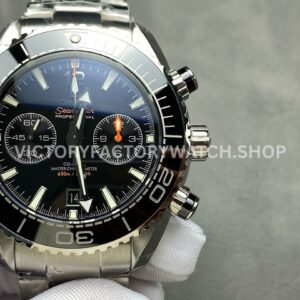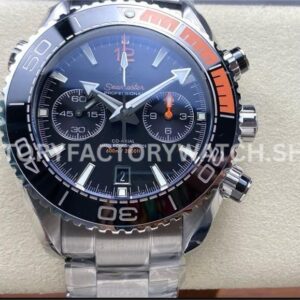

M+S Factory
M+S Factory Background
Public information on M+S Factory is still quite limited, but it is far from being a name without shape. Based on the public traces that can currently be tied to it with reasonable confidence, M+S is most clearly associated with the Omega Seamaster Planet Ocean Chronograph line, rather than with the broad multi-brand coverage seen in more established factories. The most realistic way to understand M+S at this stage is as a low- to mid-visibility niche factory label that built recognition around the Omega Planet Ocean Chronograph.
From a product-logic perspective, the fact that M+S chose the Planet Ocean Chronograph as its main direction already says a lot. This is not a low-threshold subject that can pass simply by getting the case shape roughly right. What the market actually judges on this watch includes the overall case thickness, subdial layout, date placement, bezel details, pusher and crown proportions, total wrist weight, and whether the chronograph functions feel usable in real life. It is a category that naturally carries more scrutiny, because the genuine watch itself is already a large, heavy, visually strong Omega sports chronograph.
M+S is worth documenting not because its public exposure is particularly large, but because its point of entry is unusually specific. In the replica market, many factories first build awareness through popular three-hand models and only later move into more complicated watches. The Planet Ocean Chronograph does not really fit that route. Demand for it has always existed, but the discussion around it tends to remain very practical: does it look right, is it too thick, and is the chronograph something buyers would actually trust using. That is exactly why any factory that keeps appearing in this segment can be remembered by a certain group of buyers. M+S seems to have left its name in the market through that kind of path rather than through wide product coverage.
Placed back into the broader Omega replica market, M+S becomes easier to understand. Omega has never been defined only by the Seamaster 300 or the Moonwatch. A watch like the Planet Ocean Chronograph, which is thicker, heavier, and more visually aggressive, has also had stable demand for a long time. But the market logic around this category is different from a standard diver. Buyers will not look only at the dial and the case. They care about whether the watch feels overly thick, overly heavy on the wrist, whether the chronograph structure feels stable enough, and whether the whole watch works as a convincing daily-wear sports chrono. Public discussion around the Planet Ocean Chronograph has long been tied to familiar topics such as A7750-based movement routes, excessive thickness, and the tendency for subdial or date positioning to create visual problems, which means that any factory entering this line will struggle to build reputation through marketing language alone.
That also defines the market character of M+S. It does not look like a classic technical-myth factory. In the publicly visible material, there is no clear long-running narrative around integrated clone movements, generation-by-generation upgrades, parts compatibility, or systematic teardown culture. The more realistic picture is that M+S first entered circulation through actual finished watches, and only afterwards began to be recognized as a factory label in scattered buyer conversations. In other words, the market seems to remember that there is an M+S version of the Omega Planet Ocean Chronograph, and only then starts forming a rough impression of the factory itself. That is very different from stronger factories, where the name often comes first and the products follow.
From a realistic positioning standpoint, M+S should not be described as a top Omega factory. The reason is simple: the publicly available material is still too thin, the amount of high-quality outside discussion is very limited, and there is no long, continuous, multi-generational public record that would support a stronger claim. At the same time, it would also be inaccurate to dismiss it as a completely empty label with no real circulation base, because the Planet Ocean Chronograph is not an easy category to fake convincingly. A factory that can remain associated with this line over time clearly has some degree of real market circulation in that niche. The more realistic place to position M+S is as a mid-tier factory label with low to medium public visibility, recognized mainly through the Omega Planet Ocean Chronograph.
From an industry perspective, M+S is also very typical. The replica market is not always defined by the highest-traffic steel sports watches. Many factories are remembered precisely because they remain active in a subcategory where demand remains steady, but where public competition is not as overcrowded as in the biggest battlegrounds. The Planet Ocean Chronograph is exactly that kind of watch. It does not appear as frequently as the Submariner, Daytona, or Royal Oak, but it has always had a stable audience, and buyers who choose it tend to care a great deal about thickness, wrist feel, functionality, and total finishing. M+S has left a trace in the market because its entry point is specific enough, and because users of this kind of watch can judge its strengths and weaknesses very quickly once it is in circulation.
Overall, the most accurate way to define M+S Factory is not as a broad multi-brand factory, and not as a mature maker with a fully formed public reputation system. It is better understood as a low- to mid-visibility factory label that entered the market through the Omega Seamaster Planet Ocean Chronograph and gradually built presence inside Omega’s sports-chronograph niche. Its market presence was not created through a wide spread of models, but through one Omega subject that already places real demands on thickness, structure, and visual completion. This path is not loud, but it is much closer to the real market than vague descriptions suggesting that the factory “does everything.”